
How will we be after AI?
In the past, politics was mostly concerned with material and social conditions. Increasingly, a place in our democracy for the psychological condition needs securing.

In the next decade, politics will become a battle for our minds. Ultimately, political outcomes are social processes where we are shaped through ideas, interests, culture, institutions and relationships. In the past century, these processes have been mediated through modern technology: mass media, the internet, social media and, increasingly, AI.
With each technological wave, we have failed to consider its impacts until they are in the rear-view mirror. And as we try to catch up with the consequences of social media, we are missing a transformation of our public sphere that could be as great – if not greater.
All of the political energy around culture and technology – an increasingly fiery ball of energy – has been devoted to social media. There’s a pattern. When new technologies arrive, the first response is laissez-faire and then, as malign impacts are realised, the dirigiste lever is yanked hard. In the case of the current moment, that means banning social media access for under-16s.
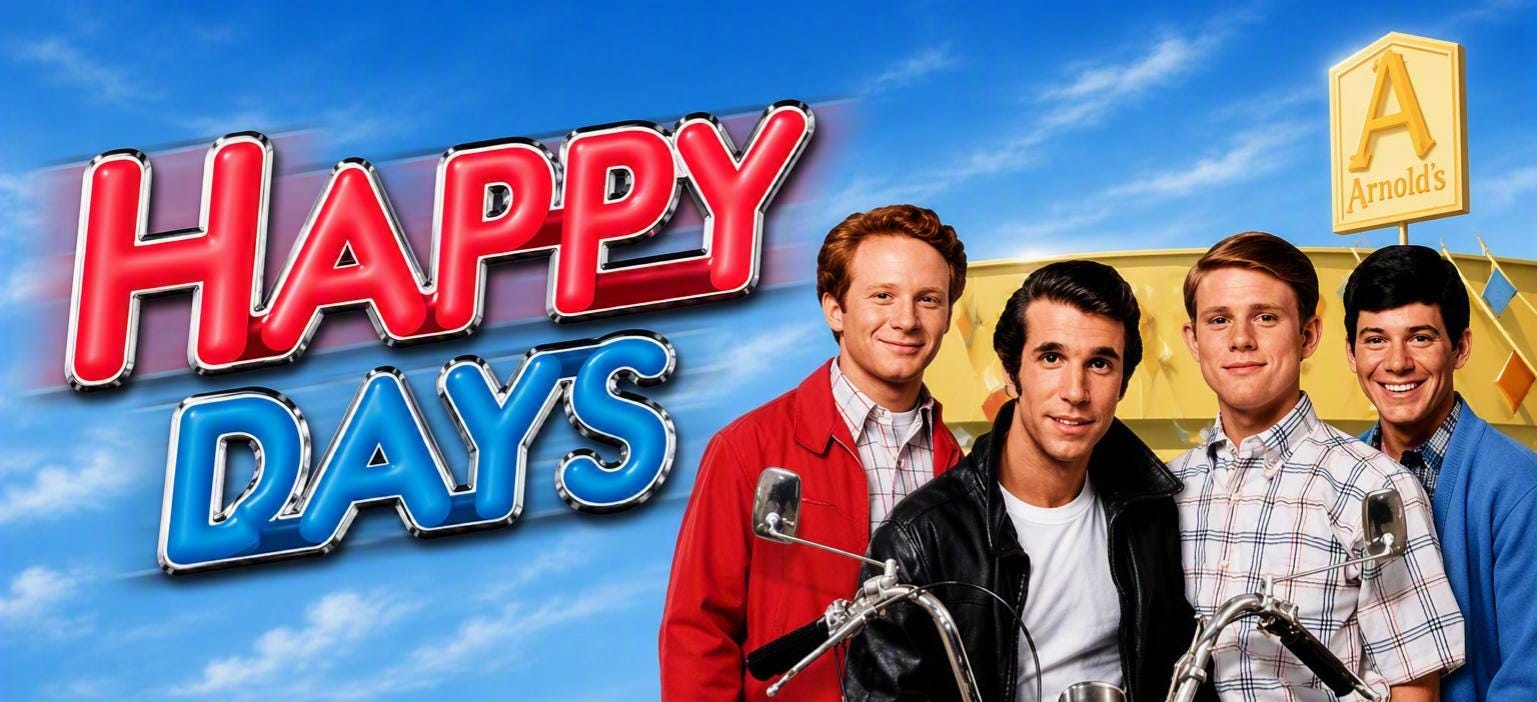
The debate is framed as current malaise versus what has been lost — a childhood of outdoor play, friendship, family, literature, study and purpose. Now teenagers have nothing but misery, loneliness and anxiety. We had Happy Days and now all kids have Fortnite. And, remember, we were happy and free.
It’s easy to get distracted by the caricatured nature of the discourse. There are deeper issues at play. We now have a three-decade-long intensification of mental health conditions. As a recent independent Government review concluded:
“The prevalence of common mental disorders, principally anxiety and depression, among adults in England has risen from around 15% to 16% in the early 1990s to around 23% by the mid-2020s, with the clearest increases observed among young adults.”
And this can be seen across the time period:
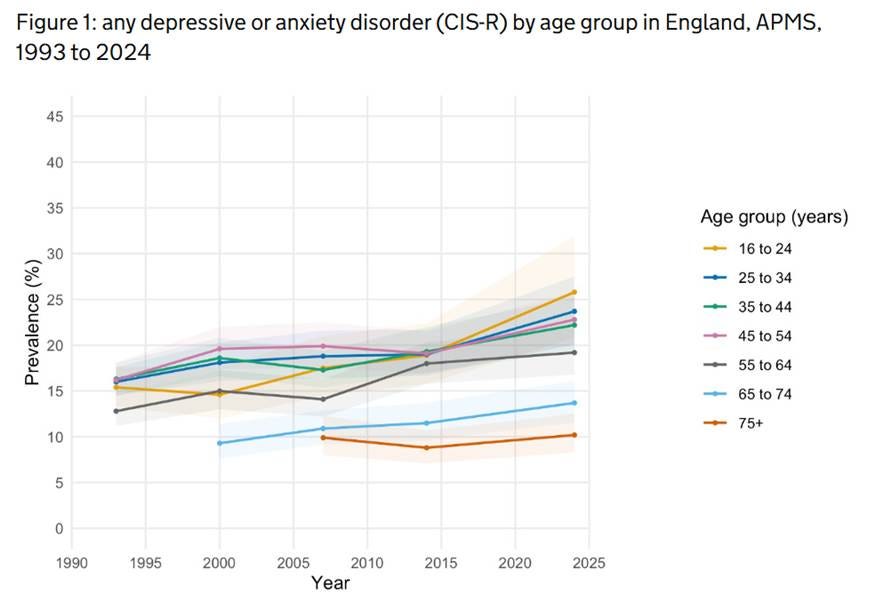
We see steady increases in the early part of this century and then an acceleration in the 2010s. The problem is that there is a lot going on in that decade beyond smartphones and social media: the aftermath of a global financial crisis, decreased feelings of satisfaction at school, Covid, and declining investment in youth mental health and social supports. Whether banning social media for under-16s is the right response given the evidence — and there is a case for it under the precautionary principle — it doesn’t get to the heart of what is clearly a longer-standing and broader mental health challenge, which social media is likely exacerbating for a subset of young people, especially girls.
The response also doesn’t get to grips with the broader ways in which technology is bending our society out of shape, undermining trust and common understanding through mis- and disinformation, and increasing fragmentation and polarisation. This is about adult use of social media not just teenagers. The big problem with where we have ended up is that we are neither confronting the mental health challenge in the round nor dealing sufficiently with the impacts of technology. Meanwhile, AI is in the room.
In fact, not only is it in the room; as we ban social media, it becomes more likely that young people will turn to AI. Here, I am referring specifically to generative AI, which has a particular structure and form that we experience through chatbots like ChatGPT, Claude or Gemini, or through AI agents. Social media has created human interactions and relationships while diminishing distance. This facilitates tribes and extremes as much as it opens us to a global conversation in more idealised accounts. Bad actors link up bubbles of association and interest, creating fear, anxiety, loathing and political mobilisation of different forms. It’s not all bad: good actors can similarly spread knowledge, support, belonging and meaning.
AI does something else: it destroys social distance altogether, by creating a social barrier. You interface with the AI or chatbot and it becomes your singular interlocutor. It becomes your window on the world. You are relationally conjoined. This is why generative AI is a conversational medium — albeit one where the individual is conversing with a machine. Yet, over time, that fact blurs.
Now, it is important not to overstate the pace of cultural transformation that this new form of human “social” relations constitutes. There is genuine pushback. For example, many young people reject AI on the basis that they don’t trust or like it. In fact, trust in AI in general is steadily declining over time and negative across all age groups and genders.
There are deeper warning signs too. We are easily hoodwinked into believing that we engage in a parasocial relationship — the one-sided kind some people have with celebrities — with AI, which can deepen and encourage increasing disclosure of personal and sensitive information. As one study reports:
“These agents are available 24/7 at little or no cost, making them more accessible than most personal or professional support. Emotionally, users need not worry about the agents being ‘annoyed or judgmental’ due to frequent interactions. These judgment-free impressions of agents, accompanied by their positive, affirmatory responses, particularly encourage users to disclose more during interactions, which, again, contributes to reinforcing relationship development and reliance.”
So where an anxious, depressed or lonely teenager might today turn to an online community or algorithmic social media, they will be more likely to turn to an AI in the future. The social media landscape may exacerbate or alleviate their symptoms (which is why comparisons between smoking and social media are cut-through communications but bear little relation to reality — social media can have negative health impacts, but it can also have positive ones, such as helping people find fellow travellers to navigate life). In the new world, the AI could well be the outlet.
It might be that, given AI’s sycophancy, and with responsible design, it could be palliative. Yet the fear has to be that dependence on AI agents will actually separate young people further from their social lives — it is ultimately a purely individualistic experience in “conversation” with a machine. That doesn’t sound at all good in the medium term.
The individual interacting with the chatty machine has wider political ramifications too. It is not just a machine, of course. It is designed in a particular way by particular people with their own biases and interests.
Oddly, in this early-stage era of generative AI, models often display progressive or centrist outputs when asked questions with political resonance. They quickly shunt right, as a result of either sycophancy or instruction, when they realise their human is right-leaning. Of course, it might be that progressive or centrist positions are more grounded in fact on average (misinformation has generally been more associated with the right over recent years, though that could, of course, flip). But let’s put that self-serving idea to one side. That leaves two issues: first, that outputs related to political questions are non-neutral; and second, that political perspectives are reinforced via generative AI.
Once we see that political outputs can be biased by AI model training data, model axioms, training processes and weighting, it is not difficult to imagine biases being deliberately built into models. And, indeed, that is exactly what X did with Grok, albeit in an incredibly cack-handed way. More subtle techniques may reap bigger dividends over time. Some people will use models that separate them from the mainstream quite deliberately as a form of AI self-radicalisation. We also know that countries with less press freedom see more pro-government AI outputs. Basically, if you are a government or a big tech overlord, you can heavily manipulate the information space. In fact, you might be encouraged to do so given the amount of neurological real estate you can acquire. Such real estate is political and cultural power.
Furthermore, the dynamic of an individual conversing with a machine might create a more hermetically sealed filter bubble. You can infinitely reinforce whatever political perspective you like with increasingly little relation to objective reality, and without challenge.
All of which means that, beyond the impact of AI on work, risk, productivity and growth, we face another battle for our minds. The battleground is our mental health, our society and our democracy. In the past, politics was mostly concerned with material and social conditions. Increasingly, a place in our democracy for the psychological condition needs securing.
That is why the conversation about social media has been so unsatisfactory. We must look at all the psychological technologies in the round. Each must be understood in terms of its effects and, also, how they interact. It is not good enough to chicane from laissez-faire to dirigisme until the next technological wave comes along. Democratic and sovereign will — grounded in the public good — must guide future regulation and legislation more firmly.
To return to the core question of this piece: how will we be after AI? The honest answer is that we can influence that, but only if we take proactive control now rather than wait, as we did with social media, until it is too late and then panic. It will likely change us. We should have a vote in how.
In response (on Bsky) to Will Davies excellent new piece, I mused that part of people feeling the state is failing might be (for the grey vote) that the grey voter probably receives 3 spam calls a day. Just another little piece of the psychological puzzle about why people feel things are falling apart.
Your mind can never rest. I suspect that leans in an authoritarian direction- who is going to grip this? Or escapism. Older voters the former, younger the latter. Neither is good for a collective progressive democratic project which needs high trust.